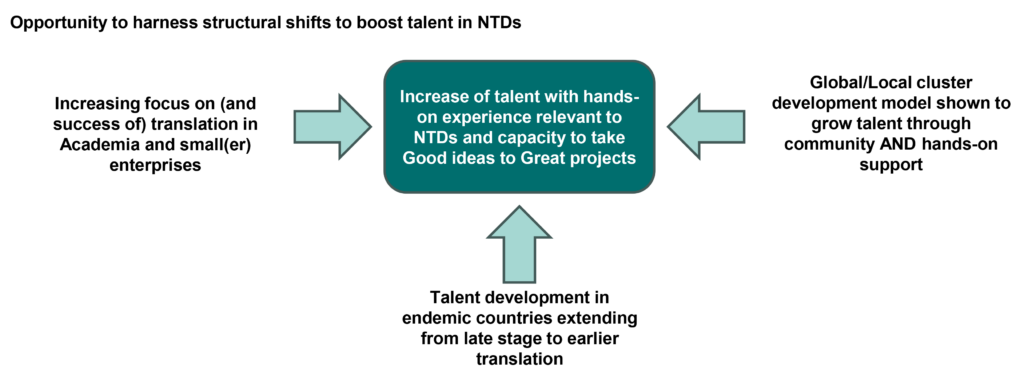
Structural shifts in the broader innovation landscape create an opportunity to broaden the talent and resource pool working on early stage development in NTDs. These shifts include; an increasing role of academia and small teams in development, R&D talent development in endemic countries and global cluster development.
Increasing role of Academia and small teams
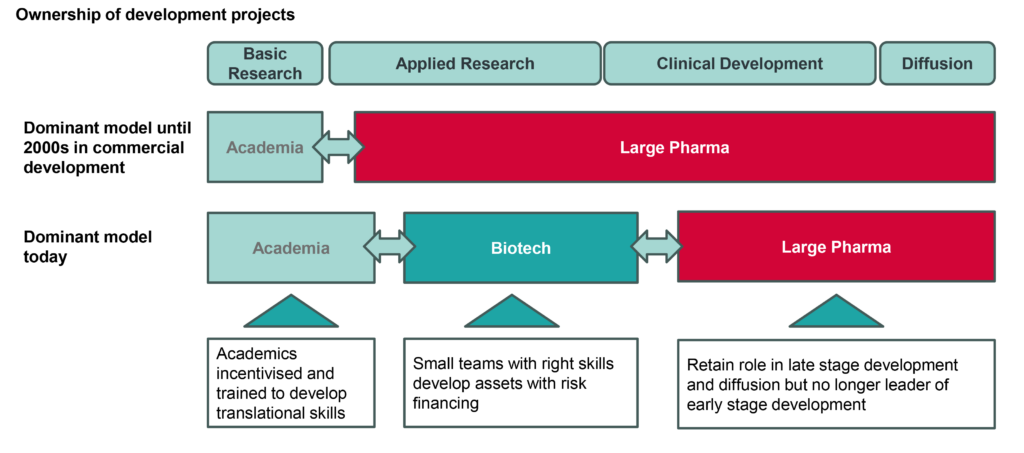
Drug development is no longer the big pharma model that dominated when PDPs first launched but rather it is driven by academia and biotech. The share of clinical trials with a Top-10 Pharma sponsor has dropped from 70% in 2003 to around 30% in 2017 and the number of companies with a visible pharmaceutical pipeline has grown from 300 in 2000 to over 1000 in 2020.
In addition to numbers, Academia and small Pharma have been bringing more innovative products to the clinic; of the First in Class (FIC) drugs in Oncology only 18% originated from traditional Medium and Large Pharma whilst 46% came from Small Biotech, 14% Academia, with the remaining 22% being a collaboration.4 This change has been enabled by the democratization of biomedical R&D through technology platforms, maturation of an outsourcing industry, entrepreneurial academics and an investment industry able to bring risk ready capital and the judgement needed to allocate it.
There are already examples of development in Neglected Diseases led by small teams such as Medicines Development for Global Health (MDGH) completing the development and launch of Moxidectin as a treatment for river blindness with philanthropic venture funding and then gaining a Priority Review Voucher to help fund the launch. The Pediatric Praziquantel Consortium a small PDP brought a Pediatric treatment for schistosomiasis to the market with the Swiss TPH leveraging industry partners and building a consortium and funding over time.
Increasing role of research and development in Endemic countries
In the field of neglected diseases there is an increase in both research and development in and led by partners in endemic countries. EDCTP has shown that clinical trial capacity can be developed across endemic countries and other initiatives in manufacturing and drug and vaccine development have also gained traction, particularly post the COVID pandemic. The majority of these initiatives have focused on late stage development and implementation but there are also examples of drug development groups e.g. H3D in South Africa, Drug Innovation Group in Ghana at the Noguchi institute, SPARK Africa and Fiocruz and Butantan in Brazil.
These groups have the unique opportunity to make an impact due to understanding of the market but successful drug development is based on access to experience and specific resources. Just as any drug development program in Europe would need access to a global network of expertise and resources so to will the programs originated in Low and Middle Income Countries.
Glocal clusters
Clusters of innovation support the development and curation of activities along the innovation value chain with a combination of talent, know-how, resources and decision making. Geographic clusters such as Boston, Silicon Valley, Milan or Shenzhen dominate industries as a particular part of the value chain or whole industries converge making participants more effective which attracts more resources in a virtuous cycle. No one actor dominates a cluster but rather talent and resources are recycled across different entities with the cluster learning and developing faster than any actor could on their own.
Harnessing the opportunity with a network incubator – SPARK NTD
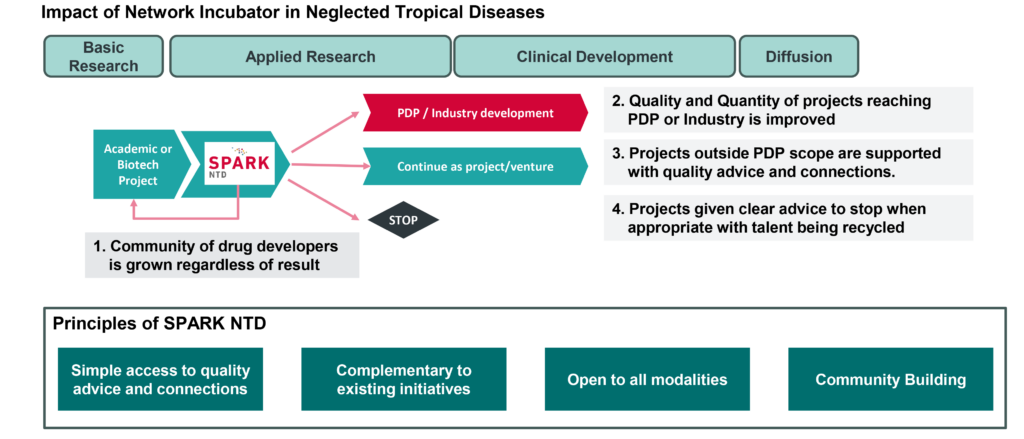
SPARK NTD will provide uncomplicated access to expertise, resources, training and eventually funding to boost the pool of talent working on early-stage development of interventions against Neglected Tropical Diseases. This network can be built initially with translation minded academic and public health partners supported by a small collection of experts with industry experience and over time grow to engage with later stage actors such as the PDPs and industry as well as further sources of funding.
This would build on the existing SPARK model for support of academic projects and the experience of INCATE in developing a global community in early stage development of interventions against drug resistant bacteria. The support would crucially not be limited to ideas and projects from partner institutions but open to all.
This action would complement existing capacity building such as EDCTP3 focused on clinical trials and implementation as well as the growing community of drug developers in endemic countries. It would also complement existing discovery efforts and community building actions from the PDPs.
In a similar way SPARK NTD would boost the community of drug developers in NTD and over time also project numbers and quality